Learning Outcomes
After completing this lesson, students will be able to:
i. Identify and differentiate between different types of database models
ii. Understand the structure and relationships within hierarchical, network, relational, object-oriented, and object-relational databases
iii. Recognize the strengths and limitations of each database model
iv. Choose the appropriate database model for a given application
Introduction
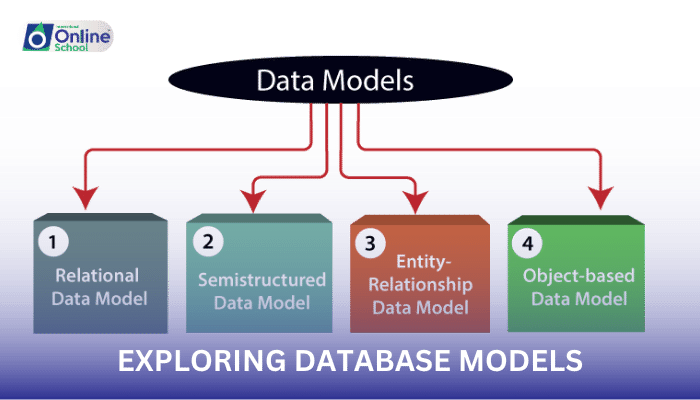
In the realm of data management, database models serve as the blueprints for organizing and representing data within databases. These conceptual frameworks define the structure, relationships, and rules that govern how data is stored, accessed, and manipulated. Understanding the different types of database models is crucial for selecting the most suitable approach for a particular application and ensuring efficient data management. This lesson delves into the world of database models, exploring their characteristics, structures, and applications.
i. Hierarchical Database Models: A Tree-like Structure
Hierarchical database models organize data in a tree-like structure, with entities arranged in a parent-child hierarchy. Each parent entity can have multiple child entities, but each child entity can only have one parent. This model is well-suited for applications where data has a clear hierarchical relationship, such as organizational structures or product catalogs.
ii. Network Database Models: Expanding Relationships
Network database models expand on the hierarchical model by allowing for multiple parent-child relationships. This flexibility enables them to represent more complex data structures and relationships. Network models are often used in applications that require intricate data linkages, such as social networks or transportation systems.
iii. Relational Database Models: The Tabular Paradigm
Relational database models, the most widely used type, represent data in tables, each with rows (records) and columns (fields). Relationships between tables are defined through referential integrity constraints, ensuring data consistency. Relational models are versatile and efficient for handling large volumes of structured data, making them popular for various applications, including e-commerce, banking, and healthcare.
iv. Object-oriented Database Models: Embracing Objects
Object-oriented database models incorporate the concepts of object-oriented programming, storing data in objects that encapsulate both data and its associated behavior. This model provides a natural fit for applications that deal with complex objects and their interactions, such as engineering design or multimedia data management.
v. Object-relational Database Models: Bridging the Gap
Object-relational database models combine the strengths of relational and object-oriented models, enabling them to store and manage both structured and unstructured data. This hybrid approach is particularly useful for applications that require a combination of traditional data management and object-oriented modeling.
vi. Choosing the Right Model: A Case-by-Case Decision
The choice of database model depends on the specific requirements of the application. Factors to consider include:
Data Structure: The type and complexity of data relationships
Data Volume: The amount of data to be stored and managed
Data Access Patterns: The frequency and type of data retrieval and manipulation
Application Requirements: The specific needs and functionalities of the application
Database models provide the foundation for organizing, representing, and managing data within databases. Each model has its strengths, limitations, and suitable applications. Understanding the characteristics and capabilities of different database models is essential for selecting the most appropriate approach for a given application, ensuring efficient data management and enabling organizations toharness the power of their data for informed decision-making and success.
